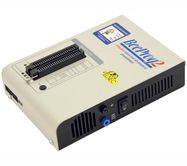
Программатор BeeProg2C 60-0059 ELNEC
Сроки доставки
Товар заказывается со склада поставщика. Если поставщик не сможет доставить данный товар до указанной даты, мы информируем Вас по электронной почте.
 Доступно Доступно | Склад поставщика |

Обработка заказов
Обработка заказов
Количество в магазине
 Недоступно Недоступно | Lemona Центральный склад (доставка 1-3 р. д.) |
| Недоступно | Другие склады Lemona |

Доставка на дом
Доставка на дом
Более 50,00 € (Заказы до 1000 кг) | Бесплатно |
К 50,00 € (Заказы до 1000 кг) | 5,00 € |

Получение в почтомате
Получение в почтомате
3,50 €
Описание товара

Extremely fast universal USB interfaced programmer.
Cost effective version of BeeProg2 programmer (differences see below). If you need to program some of the mentioned devices, see BeeProg2 programmer.
Short description:
- 133604 supported devices from 450 manufacturers by 3.99 version of SW (09. Jan. 2025)
- extremely fast programming, one of the fastest programmers in this category.
Sustainable programming speed greater than 5 MBytes per second.
Programs 2 GB eMMC NAND Flash in less than 365 sec. - 48-pins powerful pindrivers, no adapter required for any DIL devices
- ISP connector for in-circuit programming
- connection to PC: USB 2.0 (up to 480 Mbit/s, high speed/full speed) and 1.1 compatible interface
- after upgrade to BeeProg2, also high-speed IEEE 1284 (ECP/EPP) printer-port (LPT) interface is available
- USB 2.0 (high speed, full speed) and 1.1 compatible interface
- alternatively high-speed IEEE 1284 (ECP/EPP) printer-port (LPT) interface
- comfortable and easy to use control program, works with all versions of MS Windows from Windows XP to Windows 11 (32-bit and 64-bit*) running at x86/x64 compatible PC
- unique quick reaction to customer's needs - software update can be ready within a day from request by OnDemand software
- Multiprogramming possible by attaching more programmers to one PC
- made in Slovakia
- warranty - 3 years
- approved by CE laboratory to meet CE requirements
General
- BeeProg2C is USB-compatible, MS Windows (from Windows XP to Windows 11, 32-bit and 64-bit) based Elnec universal programmers, built to meet the strong demand of the small manufacturing and developers community for the fast and reliable universal programmer.
- BeeProg2C programmer have hardware identical with the BeeProg2 programmer, the differences are only in software. BeeProg2C have next limitations against BeeProg2:
- unsupported obsolete bipolar chips (PROMs and PLDs)
- unsupported obsolete EPROMs with programming voltage 21V and above
- unsupported obsolete 2708 EPROMs
- unsupported obsolete microcontrollers MCS48 series
- unsupported obsolete microcontrollers 8751/8752 with programming voltage 21V and above
- unsupported some very obsolete chips and special implementations
- LPT port connection usage is disabled in software
- BeeProg2C programmer can be any time upgraded to BeeProg2 using BeeProg2C to BeeProg2 upgrade kit
- Supports all kinds of types and silicon technologies of today and tomorrow programmable devices without family-specific module. You have freedom to choose the optimal device for your design. Using built-in in-circuit serial programming (ISP) connector, the programmer is able to program ISP capable chips in circuit.
- BeeProg2C isn't only a programmer, but also a tester of TTL/CMOS logic ICs and memories. Furthermore, it allows generation of user-definable test pattern sequences.
- Provides very competitive price coupled with excellent hardware design for reliable programming.
- Extremely fast programming due to high-speed FPGA driven hardware and execution of time-critical routines inside of the programmer. As a result, when used in manually-operated production, this one-socket-programmer in most cases waits for an operator.
- BeeProg2C interfaces with any IBM PC compatible personal computers, running MS Windows OS, through USB (2.0 HighSpeed). After upgrade to BeeProg2 can be also used through parallel (printer) port.
Hardware
- FPGA based totally reconfigurable 48 powerful TTL pindrivers provide H/L/pull_up/pull_down and read capability for each pin of socket. Advanced pindrivers incorporate high-quality high-speed circuitry to deliver signals without overshoot or ground bounce for all supported devices. Improved pin drivers drivers operate down to 1.8V so you'll be ready to program the full range of today's advanced low-voltage devices.
- The programmer performs device insertion test based on the check of proper signal path between the programmer and programmed device before it programs each device. In dependence on programming configuration it identifies missed or poor contact between programmed device and the ZIF socket of the programming adapter (or the programmer directly), missed or poor contact between the programming adapter and the programmer and it's also able to indicate wrong position of device in the ZIF socket of the programmer / the programming adapter (moved, rotated, backward oriented). These capabilities, supported by overcurrent protection and signature-byte check help prevent chip damage due to operator error.
- The selftest capability allow to run diagnostic part of software to thoroughly check the health of the programmer.
- Built-in protection circuits eliminate damage of programmer and/or programmed device due to environment or operator failure. All the inputs of the BeeProg2C programmer, including the ZIF socket, connection to PC and power supply input, are protected against ESD up to 15kV.
- When programming specification require, the (BeeProg2C) programmer performs programming verification at the marginal level of supply voltage, which, obviously, improves programming yield, and guarantees long data retention.
- Various programming adapters are available to handle device in PLCC, JLCC, SOIC, SDIP, SOP, PSOP, SSOP, TSOP, TSOPII, TSSOP, QFP, PQFP, TQFP, VQFP, QFN (MLF), SON, BGA, EBGA, FBGA, VFBGA, UBGA, FTBGA, LAP, CSP, SCSP, LQFP, MQFP, HVQFN, QLP, QIP and other packages.
Software
- Programmer is driven by an easy-to-use control program with pull-down menu, hot keys and on-line help. Selecting of device is performed by its class, by manufacturer or simply by typing a fragment of vendor name and/or part number.
- Standard device-related commands (read, blank check, program, verify, erase) are boosted by some test functions (insertion test, signature-byte check), and some special functions (autoincrement, production mode - start immediately after insertion of chip into socket).
- All known data formats are supported. Automatic file format detection and conversion during loading of file.
- The rich-featured auto-increment function enables one to assign individual serial numbers to each programmed device - or simply increments a serial number, or the function enables one to read serial numbers or any programmed device identification signatures from a file.
- The software also provide a many information about programmed device. As a special, the drawings of all available packages are provided. The software provide also explanation of chip labelling (the meaning of prefixes and suffixes at the chips) for each supported chip.
- The software provide a full information for ISP implementation: Description of ISP connector pins for currently selected chip, recommended target design around in-circuit programmed chip and other necessary information.
- The remote control feature allows to be PG4UW software flow controlled by other application – either using .BAT file commands or using DLL file. DLL file, examples (C/PAS/VBASIC/.NET) and manual are part of standard software delivery.
- Jam files of JEDEC standard JESD-71 are interpreted by Jam Player. Jam files are generated by design software which is provided by manufacturer of respective programmable device. Chips are programmed in-ZIF or through ISP connector (IEEE 1149.1 Joint Test Action Group (JTAG) interface).
- VME files are interpreted by VME Player. VME file is a compressed binary variation of SVF file and contains high-level IEEE 1149.1 bus operations. SVF files are interpreted by SVF Player. SVF file (Serial Vector Format) contains high-level IEEE 1149.1 bus operations. SVF files are generated by design software which is provided by manufacturer of respective programmable device. Chips are programmed in-ZIF or through ISP connector (IEEE 1149.1 Joint Test Action Group (JTAG) interface). VME files are generated by design software which is provided by manufacturer of respective programmable device. Chips are programmed in-ZIF or through ISP connector (IEEE 1149.1 Joint Test Action Group (JTAG) interface).
- Multiple devices are possible to program and test via JTAG chain: JTAG chain (ISP-Jam), JTAG chain (ISP-VME), JTAG chain (ISP-SVF) or JTAG chain (ISP-STP).
- Attaching of more BeeProg2C programmers to the same PC (through USB port) is achieved a powerful multiprogramming system, which support as many chips, as are supported by BeeProg2C programmer and without obvious decreasing of programming speed. It is important to know, there is a concurrent multiprogramming - each programmer works independently and each programmer can program different chip, if necessary.
Полезная информация
Спецификации
Oписание товара, созданное искусственным интеллектом
Программатор BeeProg2C 60-0059 ELNEC
BeeProg2C – это высокоскоростной универсальный программатор от компании ELNEC, разработанный для быстрого и надежного программирования микросхем. Он идеально подходит для небольших производств и разработчиков, которым необходим быстрый и надежный универсальный программатор.
Основные характеристики
- Высокая скорость программирования
- Поддержка широкого спектра микросхем
- Простота использования
- Доступная цена
Функции
- Программирование микросхем
- Тестирование TTL/CMOS логических микросхем и памяти
- Генерация пользовательских тестовых последовательностей
Применение
Программатор BeeProg2C используется для программирования различных типов микросхем, тестирования логических микросхем и памяти, а также для генерации пользовательских тестовых последовательностей. Он совместим с большинством компьютеров IBM PC.
Преимущества выбора BeeProg2C
- Высокая скорость: BeeProg2C обеспечивает высокую скорость программирования благодаря высокоскоростному оборудованию на базе FPGA.
- Универсальность: Поддерживает широкий спектр микросхем различных технологий.
- Простота в использовании: Простой и интуитивно понятный интерфейс.
- Отличное соотношение цены и качества: BeeProg2C предлагает оптимальное сочетание цены и производительности.
Выбирайте BeeProg2C – надежный и эффективный инструмент для ваших задач программирования!
Данное описание создано с использованием искусственного интеллекта (ИИ) и может отличаться от реального продукта. Распространенные ошибки искусственного интеллекта могут включать:
- Неточные характеристики продукта: некоторые технические характеристики, цвета, размеры или другие параметры могут быть неточными или отсутствовать.
- Неверная информация о совместимости: ИИ может предоставлять неверную информацию о совместимости продуктов с другими устройствами или системами.
- Чрезмерно оптимистичные функции: в некоторых случаях могут быть предоставлены характеристики, которыми продукт на самом деле не обладает.
- Несоответствие названия или модели: ИИ может исказить название или модель продукта.
Если вы заметили несоответствие или у вас есть вопросы по описанию, пожалуйста, свяжитесь с нами до покупки продукта по электронной почте: [email protected]